Governance
Origins of the Initiative
How an uncommon partnership began
In December 2019, an uncommon partnership was forged in response to the growing reality of gender-based violence in the Cape Province of South Africa.
Professor Wolfgang Schürer, founder of Ring for Peace, and Dr Edwin Hertzog, then Chairperson of Mediclinic International, agreed to initiate a private-sector-led intervention to provide specialised care for victims of sexual assault. From the outset, the initiative aimed to complement an overburdened public system through effective collaboration between private, public, and research and education focused partners.
A culture of collaboration: “Saamstaan” as a guiding principle
At the heart of this initiative lies a deeply rooted local culture of “Saamstaan” — standing together.
This spirit, visible during periods of drought and throughout the Covid pandemic, continues to shape the Ring for Peace approach: people coming together across sectors to respond collectively to complex social challenges.
From pilot to system learning
The partnership with Mediclinic
The first phase focused on piloting specialised GBV care within three Mediclinic Emergency Centres: Stellenbosch, Paarl, and Worcester. This stage combined targeted clinical training, community engagement within Mediclinic’s predominantly female nursing workforce, and local media awareness campaigns to ensure survivors know where to seek help.
Exponential learning & the need for a new model
The learning from the pilot phase was profound. Despite the seemingly idyllic setting of Stellenbosch, reported sexual assault cases range between 600 and 800 per year — estimated to represent only around 10% of actual incidents. The majority of survivors are children under the age of 16.
These realities made clear that incremental improvements were not enough. A fundamentally different, community-based model was required.
A first-of-its-kind GBV Care Centre
From learning to implementation
Lessons from the pilot phase highlighted the importance of proximity to affected communities, discreet and safe locations, and direct access to local police and support services.
These insights led to the establishment of the Stellenbosch GBV Care Centre — a first-of-its-kind, fully integrated, community-based care model developed through unprecedented collaboration between public and private partners.
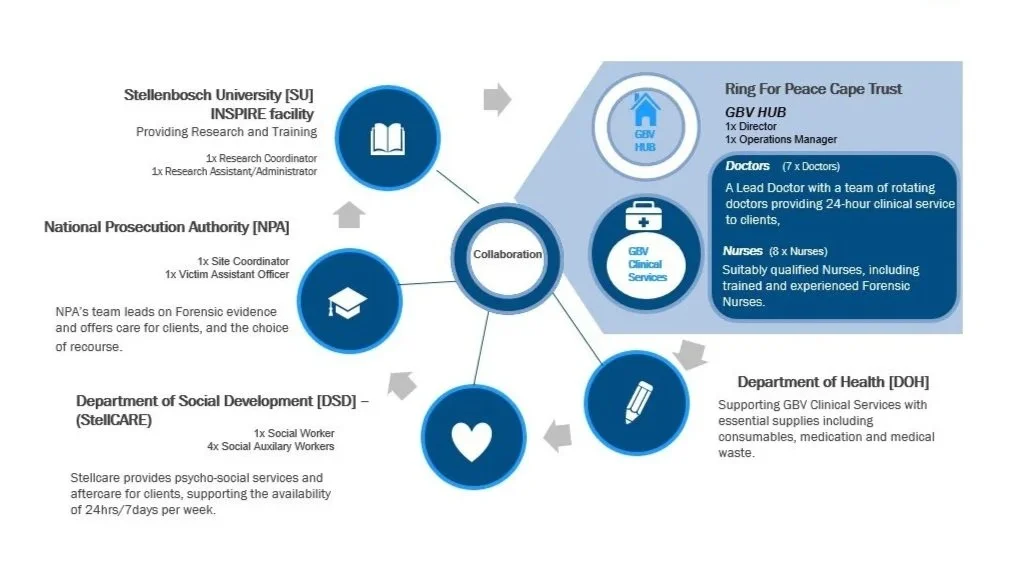
How the structure works today – an integrated service model
The Stellenbosch GBV Centre operates through an integrated structure aligning medical care, psychosocial support, justice services, and community-based aftercare.